







• Residential: $231.150 (up to 2,300-square-foot building) plus $0.1005 per square foot over 2,300 square feet.
• Nonresidential: $603.98 (up to 2,300-square-foot building) plus $0.2626 per square foot over 2,300 square feet.
• Vacant lot: $140.456.
• Undeveloped acreage: $140.456 plus $46.8186 per acre over 3 acres.
According to Fire Chief Kevin Lewis, it’s necessary to meet growing service demands, ever-increasing operating costs and to retain HNFD’s firefighters.
“The referendum is to catch us up,” Lewis said. “We have gone years and years without a substantial increase. We are way behind on operational costs; our reserve fund is lower than it should be and the pay for firefighters being at minimum wage is hurting with recruiting and retention.”
The district is currently operating on a $4 million budget and serves the community through two fully staffed stations. There is also an additional station that is partially staffed due to a small surplus left from the fiscal year 2024-25 budget. It was transferred over to the current budget.
While $4 million may sound like a lot, it dissipates quickly when personnel, operations and other costs come into play. If an engine needs to be repaired or replaced, that can also make a dent. A successful referendum would mean an increase to $6 million.
The main use of the additional funds, should the referendum pass, would be for staffing and operations.

Station 44, the most recently built of HNFD’s three stations, has yet to be fully staffed. Since Jan. 18, the station has been staffed by two firefighters per shift. For Lewis, adequate staffing means four firefighters at the station per shift.
“We are trying to fully staff our third (station),” Lewis said. “Response times are everything when it comes to saving lives and property.”
Lewis’ goal is to get HNFD to a five-minute response time from anywhere in the district. The current response time is 7 minutes, 30 seconds.
With a fully staffed Station 44, residents in Holley would have a lower ISO rating, meaning a reduction in home insurance costs.
“They will go from paying $8,000-$10,000 to paying $2,000-$3,000,” Lewis said.
Bolstering HNFD’s reserve funds is also a goal of the district.
According to Lewis, the district should maintain reserve funds equal to 50 percent of annual operating expenses, which would equate to $2 million for HNFD. Currently, however, HNFD has $400,000 in reserves.
Lewis said the district uses reserve funds to help it at the end of a fiscal year and then, once it gets the new fiscal year’s funds, it will replenish the reserves.
Personnel needs
The district has lagged on wages, too. According to statistics comparing three nearby independent special fire districts, HNFD is the lowest-paying for professional firefighters. The current hourly pay rate for HNFD firefighters starts at $15.33.
HNFD firefighters make $1.33 less per hour than their peers on Navarre Beach. Compared to Midway Fire District, HNFD’s personnel make $2.49 less per hour.
Even captains are barely making $50,000 a year, Lewis said. With limited pay, the district is at risk of losing high-quality firefighters to neighboring districts.
The low wages and the limits of the budget have led HNFD to have just 0.66 firefighters per 1,000 residents. The national average is 1.80 and the regional average is 1.50.
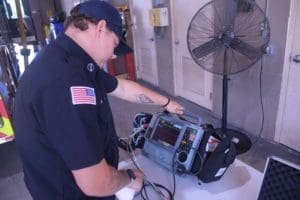
The limited pay also keeps the district from expanding the number of Advanced Life Support (ALS) certified paramedics it has. The vast majority of HNFD’s responses are to medical calls.
While the fire district can’t transport patients, the ALS engines have everything else an ambulance does, including lifesaving medication and tools.
According to Lewis, the district has averaged 400 calls a month this year. In July, the district ran 406 calls. As of Aug. 4, the district has run 2,449 total calls this year.
If the monthly average continues, the district will end the year with more than 4,400 calls. Last year, the district handled 4,349 calls.
Improvements
The district also plans to put some of the additional funding toward capital improvement projects such as building a new station near Whispering Pine Boulevard.
The district currently owns property near the intersection of Whispering Pines Boulevard and Navarre Parkway (Highway 98). As with Station 44, a new station would likely be built using a state allocation. The district is waiting for the referendum to pass before asking for money to build a station it can’t currently staff.
Lewis said future improvements could also include building a new Station 45 somewhere off Highway 87 S. or another major roadway; however, he said it won’t be anytime soon.